Showing posts with label People. Show all posts

It's about time for fashioning change


By Mary Rose Roberts
I recently stumbled across an online article about changing the way U.S. residents make their fashion choices. Let’s face it. Most Americans buy cheap fashions from retailers including Target, Old Navy and Macy’s. These are often throw-away garments: They don’t wash well, they fall apart and are out of season before they leave your closet. Even worse is that fact tiny little kid hands often make those fashions for you--and every time you buy, you support child labor or outsourced U.S. jobs.

Few of us have the time or the desire to build a proper wardrobe, like our grandma and grandpa had. They went to Marshal Fields, bought the best and something that lasted, and had it tailored to fit. We need to get back to this and reduce the waste created by the fashion industry. That is why I was attracted to Fashioning Change, a beta website that helps users find eco-alternatives to their favorite fashion brands. So I checked it, and then interviewed Adriana Herrera, founder and CEO.

For your time, Adriana is offering the following discount to readers:
Promo Code: StyleWise
Discount: 10% Off
Valid: 8/1/2012 - 8/7/2012

What was the thinking behind starting the business?
LBD from Wear This, Not That section of fashioningchange.com
I grew up with a unique lens on making purchases. My father grew up on Juarez, Mexico, a city that many consumer goods companies outsource to. He had friends and family that worked in many of the factories and knew what it meant for the people and the community to purchase one brand over the other.

He instilled in his children three rules we had to abide by when it came to making purchases:  We weren't allowed to buy things made in Asia; we weren't allowed to wear clothing made of synthetic materials; and we weren't allowed to wear dark clothing because my dad feels that children are the light of the world. From childhood, I was always thinking about where something came from, how it was made, who it was made by, and under what conditions.

I ended up co-founding a product development company and domestically manufactured eco-friendly handbags, opening up connections to designers that also were passionate about socially responsible manufacturing. So many of these designers were incredibly talented in making beautiful products, but they were forgetting the business element of reaching consumers. So to solve the problem, I decided to leverage emerging technology to build a platform that connects shoppers with brands that do fashion better.

Perfect work shirt + guilt-free!
Fashioning Change provides the missing link of providing consumers with sustainable and ethical designs that are direct alternatives to brands they already know they like.

What is Fashioning Change’s mission?
Our vision is simple: to partner with online shoppers and facilitate sustainable positive change to protect health, the earth and human rights. Together, with our partners, our goals are to create applications that help people take steps towards leading authentically sustainable and happy lives and facilitate access to information that creates transparency in what our purchases support. It also is to introduce shoppers to reliable eco-friendly and ethical brands that have the look, quality, and price points of name brands; partner with consumers to drive bottom-up systemic change in the retail and manufacturing industries; and become a partner and resource to social justice organizations that are working on human rights issues and to protect the earth.

What exactly does the site do as far as matching fashion?
Shoppers share price, style, brand and values preferences and Fashioning Change introduces carefully curated alternatives that match preferences and also protect health, the earth, and human rights. Our Wear This, Not That series gives shoppers better alternatives of on trend and essential pieces from top-name brands. We've also launched Share The Goodness, a product recommendation tool that pulls information from your friends on Facebook and provides product matches. So, if your sister loves the beach and motorcycles, you'll be able to easily suggest products that are perfect for her.

What are the challenges? Joys?
Love these socks for winter!
My dad always says, "The number one resource we have in life is time. It's the one thing we can never get back." The toughest thing about running a startup is that there's never enough time to do everything we want to do.  One of the hardest things about my job is to prioritize what we're going to do ensure that I'm creating the shortest path to positive change possible.

It's an indescribable feeling to wake up every day and know that I'm getting to work on something that is creating change and was inspired by the way I grew-up.  Not many people are able to push themselves to take the risk that the Fashioning Change team has taken.  It's amazing to see how far our hard work has gotten us.  We still have a ways to go before we fulfill our vision but it's rewarding nonetheless.

Where can you be found online/social media?
Twitter Handle: @fashion_change
Twitter:  @adriana_herrera
Facebook: Fashioning Change
Pinterest: Adriana Herrera 
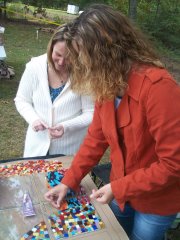
Mosaic giveaway from artist co-op


You know the drill. Comment below or on our Facebook page about this post and be registered to WIN A SET OF MOSAIC COASTERS from Marti Hartle and Leslie Compass of Soul Reflections Glass Mosaic Creations, Cape Girardeau, Mo. You have 7 days from today to enter, so don't delay!
 
What is your art?
Stained glass mosaics

How long have you two been working together?
We have been creating mosaics together for nearly 10 years.

Was running this business a dream?
I think this was more of fulfilling a dream for me than it was for Leslie. Since I was a little girl, I wanted to be an artist and own my own store. I always was making something, and I love to decorate. In Leslie's "real life," she is a nurse and I think that fulfills a lot of her ambitions. But she also has that creative side that needs an outlet. I'm so tickled she has been by my side as my best friend and my business partner. It would not be the same without her.

What was the first step you took to making it come true?
We belong to The Cat Ranch Art Guild and the president of the group, Jeanie Eddelman, was having her grand opening of a studio. We stopped in to say hello when she told us about the space for rent next door. We peeked in the window, and I knew we had to have it. Although it wasn't pretty at the time, we knew it had potential. I think the scariest part was to believe that others would want to join us in creating this co-op/studio. After talking with just a few artist friends that agreed to join us, we realized that we could really make this happen. So we contacted the owner of the building and signed the lease in July 2010 and by September had our grand opening.

Now, almost two years later, we have eight members and four guest artists in the co-op including Leslie and me. It is so nice not have to pack up for shows and pay entry fees, and travel expenses. But the best part is we are all such good friends and it is truly a happy place to be.

What are your mosaics made of?
We use stained glass scraps, beads, tiles, marbles, wood, metal, and other materials to create our artwork.

What inspires you?
We draw inspiration from meaningful day-to-day life occurrences, creating pieces from the heart.

Why is it important to reuse and renew?
It is important for us and future generations (as we are both grandmother!), because taking what some may consider "trash" and turning it into a beautiful original piece of artwork.

Where are you on social media?
You can follow us on our Art Studio Facebook page, Mozaic Art Studio or Soul Reflections. You can contact us with questions or orders through e-mail addresses: mingjow@yahoo.com or lesliecomp@hotmail.com.


Giveaway rules: Must be 18 to enter. Names will be printed and placed in a sealed box and picked at random/pure chance of winning. The giveaway ends on 12 a.m. Aug 3 , 2012. Any giveaway worth $600 must be reported to the IRS. 


Giveaway from Amy Pfaffman!


You know the drill. If you would like to win, comment below this post or 'Like' our post about this on our Facebook page! You only have 24-hours to enter!

Amy Pfaffman grew up in Birmingham, Ala. and attended the Rhode Island School of Design. Amy now lives in Marin County, Calif., in a rural area about an hour from San Francisco. With her partner, she volunteers for an organization that rescues orphaned baby raccoons. "We raise them and release them back into the wild when they're old enough to care for themselves," she said.

What made you become interested in eco-jewelry?
I college I took a course about how the design of a product has an impact on the environment (such as whether it can be disassembled for recycling). It opened my eyes to how we all effect the environment.

What materials do you use? Where do you find them?
I use whatever inspires me, and inspiration can hit almost anywhere. I have the most luck at the flea market. I also comb Ebay where I can buy treasures from other countries, like antique porcelain dolls from Germany. Materials include knitting needles, poker chips, antique dolls, vintage brass tags, vinyl records, game pieces, thimbles, watch faces and dominoes.

How do you come up with your creations?
When I see something with potential, it hits me right away. I don't always know how I'll turn it into jewelry, so sometimes ideas "gestate" for a long time before I'm inspired with a design. In every design I aim to show the material or artifact in its best light.

Why use eco-materials?
More and more I think about how much "stuff" is produced all the time, and I don't want to be a part of generating new material for landfills. Whenever I can use old materials, the wearer can experience something new while keeping something out of the waste stream.


Giveaway rules: Must be 18 to enter. Names will be printed and placed in a sealed box and picked at random/pure chance of winning. The giveaway ends on 9 a.m. on 7/7/12.


Who's who: Botanist practices what she preaches


By Mary Rose Roberts
What’s fun about redesigning a blog is the ability to step back and determine how to freshen up content. I want nextgengreen to be a community, so it’s important we get to know each other—either by volunteering to blog or by being highlighted as unofficial members of what I hope to be a very large, very inclusive international club.

So to start, I will be interviewing the winners of nextgengreen’s monthly giveaways when they are willing, starting with May 2012’s giveaway winner who is Sheri Paul. Sherri picked up a pair of upcycled earrings from WIRED owner and creator, Melissa Kolbusz.

Sherri's a botanist who gets to work in what is arguably one of the most beautiful places on Earth: Anahola, the Hawaii-Island of Kauai. Ever since she was a child, she preferred to be outdoors exploring and enjoying nature. Later, she received a bachelor's of science degree in environmental conservation and presently works for the Division of Forestry & Wildlife, preserving and protecting endangered Hawaiian plants.

“I think when you appreciate and enjoy something you try your best to protect and care for it,” she said.

Sherri makes conscious conservation decisions on a daily basis, including supporting the local economy. She shops at her local health food stores and farmers' markets. She also grows an organic garden with seeds and seedlings from the island.

“When eating out, I choose places that serve local cuisine and support our local farmers,” she said. “I also share my knowledge with friends and family and try to convince them to avoid big chain restaurants and stores.”

Sherri believes it is important to buy green products for human health and for the health of the planet.

“Every time I make a purchase, I feel I am casting a vote and that vote is for the protection of our environment,” she said. “The more people who buy green products the higher the demand for them will be and that's a great thing.”

Eco-curmudgeon greener than he thinks

By Mary Rose Roberts
Coffee shop owner Andrew Whaley isn’t anti-green. However, he is cynical of the industry and happy to pontificate about it to no end. Maybe that zest for argument comes from his philosophical and theological training at Thomas Aquinas College in Santa Paula, Calif. Or maybe it was living in California that subconsciously put his sustainable hab­­its into place. Either way, to him sustainability is about doing business with people over entities, accessing the best quality foods and saving money in the process.

Whaley owns Calix Coffeebar located in southeast Missouri, where he deploys sustainable practices starting with how he purchases coffee. He’s not a fan of fair trade but direct trade coffee. Direct trade is a form of fair trade sourcing practiced by some coffee roasters. It refers to direct sourcing from farmers and was pioneered by Intelligentsia Coffee & Tea around 2006.

Advocates of direct trade practices promote direct communication and price negotiation between the purveyor and farmer—a person-to-person discussion. In addition, customers educate farmers about the types of beans in demand in the U.S. market to reduce overdevelopment of less attractive crops and increase the growth of high-quality products.

Whaley also supports the local economy, therefore reducing the business’ environmental footprint. At Calix, mixed greens used in salads are bought nearby at Laughing Stalk Farmstead.  In addition, he purchases local raised, grass-fed, grass-finished beef because “it tastes better.” Grass-fed beef also has one-half to one-third less fat as a comparable cut from a grain-fed animal. In addition, it is lower in calories and higher in vitamin E and omega-3 fatty acids, which may help reduce the risk of cancer, lower high blood pressure and make people less susceptible to depression.

Whaley’s also nice to neighbors. After coffee grounds are used at the coffee shop, he sets up a bucket and a strainer, dumps the grinds into the strainer and waits for a local couple to come pick them up and use them as nutrients in their urban garden.

In the end, eco-curmudgeons are essential to society—especially when they help the rest of us become more eco- and sustainably aware.